To immerse oneself in another culture, one needs to be irresistibly drawn to its
strangeness, fascinated and willing to lose oneself. It is not easy to leave the
"comfort zone" of one's own familiar world for another, where all is
unpredictable and uncertain.
I have
lived in the very heart of Dakar, where foreigners generally have no reason to
go. I had a good reason to be there: I desperately wanted to learn the dances of
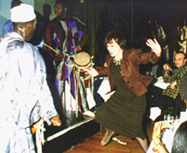
Senegal, the so called “Sabar” dances of the Wolof. They occur in neighbourhood festivals. Chairs are mysteriously brought
out at dusk and set around a big open rectangular space on any street, any day.
No one can tell you exactly where
or when it will take place, but someone can always take you to the next “Sabar”.
That is how I got to see these unique dances whose rapid leg and arm movements mesmerized me. Learning to do it myself seemed like an impossible challenge, but I was
determined. I wanted to move the way the dancers moved. I liked their
playfulness, the humor, the elegance and beauty of the steps. I liked the
controlled exuberance, the affected nonchalance, the togetherness, the sound of
the drum.
I wanted so much to blend in, but of course I did not. I felt awkward
wearing the magnificent gowns or “mbubb” that Senegalese women wear with so
much elegance and grace. Kids called me a “tubaab” -- a word meaning
"foreigner" (usually a European), and giggled when I struggled to speak Wolof, their language. I wanted to
blend in, but of course Sabar dancers do not blend in; on the contrary, wearing
the most strikingly beautiful dresses each takes a turn standing up in the
"dance circle". Each dancer assertively moves toward the drums, and
one at a time, challenges the drummers while the crowd cheers. The more
confident and playful the dancer, the more appreciative the crowd.
Becoming a Sabar dancer was perhaps the most difficult thing I did in my life.
And yet I did it -- I heard the
language of the drum, and I stood up to dance. But going back again and again to
Dakar as I did, immersing myself in the culture, I feel I learned so much more
than dance steps. I gained entrance to a totally intriguing world, where these centuries-old dances have evolved. I
gained a sense of the Senegalese
and their mores, and, of course learned about the astonishing power of rhythm to heal, to soothe and to bring people together.